
Atlanta Hotel Market Watch: Construction Boom and Recovery Divergence
Atlanta's hotel market is experiencing a construction boom with the second-largest pipeline in the nation, yet RevPAR has not fully recovered to 2019 levels. The downtown area relies on convention business and is recovering slowly, while the airport area performs strongly. Future major events such as the 2026 World Cup will drive demand, but labor shortages and economic uncertainty pose challenges.
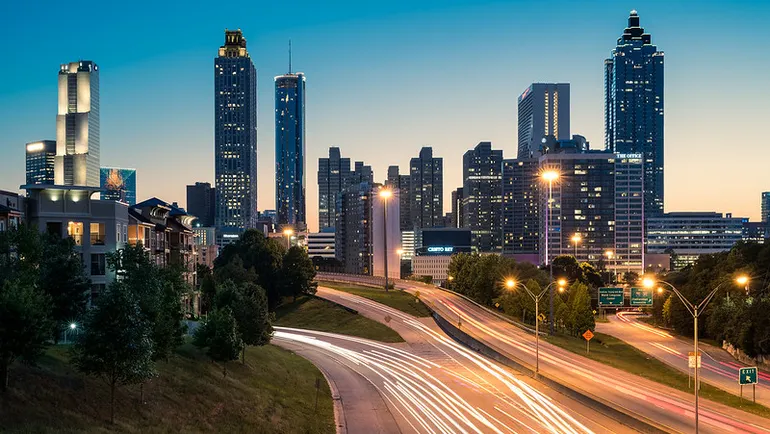
As the home of the busiest airport in the U.S., with nearly 20 Fortune 500 companies, anda thriving film and television industry, Atlanta's demand for hotels is self-evident. The city already has an ample hotel supply, and more new rooms will arrive in the coming years. As of the third quarter of 2023, Atlanta's hotel constructionpipeline ranked second in the nation, trailing only Dallas, with 140 projects and 17,775 rooms, according to Lodging Econometrics. Twenty projects are expected to open in 2024, with another 24 in 2025.
"In my early years working in the hotel industry, I witnessed Atlanta's growth firsthand," Mark Vaughan, executive vice president and chief sales officer of the Atlanta Convention & Visitors Bureau, told Hotel Dive. "During the 1996 Olympics, Atlanta had about 60,000 hotel rooms; today, that number will grow to 110,000."
Hotel Dive spoke with several experts about Atlanta's hotel performance, construction boom, and what it means for hoteliers in the "Peach State."
Market status: uneven recovery, reliant on rate growth
According to Courtney Vris, senior project manager at HVS's Atlanta office, Atlanta hotels' revenue per available room (RevPAR) peaked in 2019, and the market has not yet returned to pre-pandemic levels. However, catching up to 2019 may be harder for Atlanta than for other cities—that year, the city hosted the Super Bowl.
Citing STR data, Vris noted that citywide occupancy was 64.9% at the end of 2022, slightly below 2019's 69.5%; as of October 2023, occupancy was up 1% year over year. Atlanta's hotel market performance thus shows distinctly uneven growth.
"Similar to many markets, leisure travelers returned first," Vris told Hotel Dive, followed by business travel, and then meetings and group business. "As a result, downtown Atlanta, which relies heavily on conventions, has been particularly slow to recover," she noted, while other parts of the city have rebounded faster. "Airport passenger traffic has been very strong, and hotels around there are performing really well."
Over the past few years, the city's RevPAR growth has "been driven mainly by rate growth," Vris said, similar toother markets like New York. She expects average daily rate (ADR) growth to remain strong. "We don't anticipate a normalization or decline in ADR going forward," she said.
Brett Testa, project manager at HVS Atlanta, pointed out that the lagging occupancy recovery is closely tied to the city's hotel construction boom. "Supply growth was considerable between 2016 and 2019," he said. "I think many properties are waiting for demand to return while also absorbing new supply into the demand structure."
Construction boom: rise of boutique and lifestyle hotels
Last year, Atlanta welcomed the opening of the 16-story Hyatt Centric Buckhead, the 230-room Kimpton Shane Hotel, Margaritaville Vacation Club by Wyndham, and Nobu Hotel Atlanta. In 2023, the Four Points by Sheraton Atlanta Downtown also opened its doors. Next year, the lifestyle hotel Motto by Hilton and the convention hotel Signia by Hilton are scheduled to open.
Atlanta has never reached the level of Chicago, New York, or London... Atlanta is finding its own voice in the hotel industry.

Brett Testa
Project Manager, HVS Atlanta
Although the hotels that have opened or are planned vary in size and positioning, it is boutique and lifestyle hotels that are truly stirring Atlanta's market, said Vaughan of the Atlanta Convention & Visitors Bureau. "Community character is often shaped by boutique lifestyle hotels; 15 to 20 years ago we were severely lacking in that area, but now we're doing well," he said, citing Hyatt's Thompson Atlanta - Buckhead as a "very cool lifestyle hotel."
However, when talking with Atlanta hoteliers,everyone mentions one project: the Signia by Hilton, slated to open in spring 2024. This 976-room hotel will be the largest new build in downtown Atlanta in 40 years and the first new-build property for Hilton's new Signia brand. With its room count, location adjacent to the Georgia World Congress Center and Mercedes-Benz Stadium, and what is touted as the largest hotel ballroom in Georgia (7,888 square feet), the hotel aims to attract those attending events and conventions—a primary driver of Atlanta's hotel occupancy.
Conventions and events: driving demand and construction
According to Vaughan, Atlanta will host 18 events in 2023 with peak-night room demand exceeding 5,000 rooms, with 21 expected in 2024. "There are 13,000 hotel rooms within a mile of the Georgia World Congress Center," Vaughan said. "When the market reaches 20 such large events, it strongly boosts many industries and is very beneficial to the sector."
Events driving Atlanta's business travel
Testa of HVS Atlanta noted that future events are driving more construction. In particular, the 2026 World Cup is expected to attract a large number of sports fans. "I think many people want to complete projects before the World Cup," he said, "but even after that, the infrastructure built for the World Cup will create years of stickiness for group travel."
Although business travel contributes the majority of Atlanta's room demand, Vaughan said, "our leisure product is equally excellent." In October 2023, the Michelin Guide released itsfirst Atlanta restaurant guide, with some restaurants located in hotels—for example, Atlas at The St. Regis Atlanta has now earned a one-star rating.
Potential challenges: economic uncertainty and labor
Despite Atlanta's strong hotel market, the city's hoteliers face the same issues as their counterparts elsewhere. "The main headwind we acknowledge when serving clients is widespread economic uncertainty," Vris said. "This is at the national macro level."
Vaughan believes the biggestchallenge for hotels in the area is labor. He said that when Signia by Hilton opens, it will provide 700 jobs, "which could put some pressure on the market."
"Hotels that pay fair wages don't seem to have this problem," Testa said. "It seems to be a game you can choose whether to play."
"Beyond new supply and labor, I think Atlanta is a mature market," he added. "The key is filling existing gaps and cultivating a deeper hotel culture. Atlanta has never reached the level of Chicago, New York, or London, but I think it's growing and strengthening. Atlanta is finding its own voice in the hotel industry."