
Tip Tax Exemption or Coming Soon: What Changes Will the Hospitality Industry See?
The legislative process to eliminate federal taxes on tips is accelerating: the Trump-backed 'One Big Beautiful Bill' has passed the House and been sent to the Senate, which previously also passed Cruz's 'Tax-Free Tips Act.' Hospitality associations and unions generally support it, but the bill's details, scope of application, and actual impact on low-income workers remain contentious.
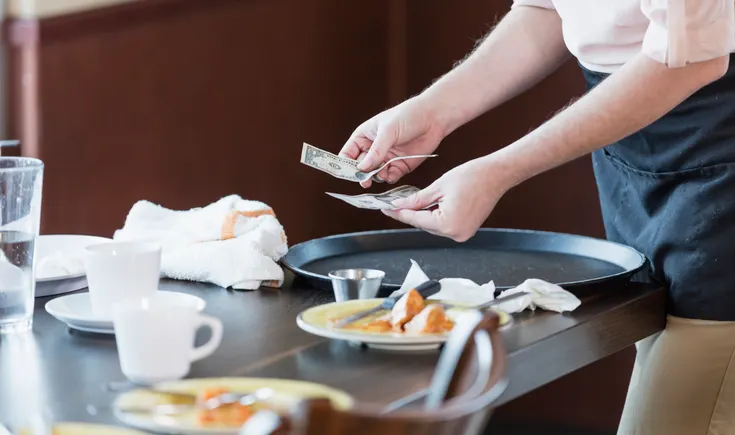
When Erin Scott first heard about the proposal to eliminate taxes on tips, her initial reaction was: "This is a great idea."
Scott is a cocktail server at Harrah's Las Vegas. She told Hotel Dive that tips are a significant part of her income, and on some days they can be quite substantial. But working as a tipped employee is complicated—customers' tipping habits fluctuate widely, and the tips she actually receives are often far less than customers assume.
"Guests tip you because you took care of them. They give that tip as a gift," she said. But she noted that guests often don't realize these tips ultimately get split among bartenders, bar backs, and "Uncle Sam" (referring to the U.S. government).
Scott is among those in the hospitality industry supporting the elimination of federal taxes on tips, a group that includes hotel employees, hotel associations, and hotel unions.
And that elimination could soon become a reality: the tax and spending reconciliation package supported by President Donald Trump—known as the "One Big Beautiful Bill"—passed the House in May and has been sent to the Senate.
The House-passed version outlines budget priorities, including tax cuts, cuts to spending on services like Medicaid, and increased funding for priorities such as border security that Trump campaigned on. The bill also includes a provision to eliminate federal taxes on tips. Before the bill reached the Senate, the Senate had passed the "No Tax on Tips Act" introduced by Republican Senator Ted Cruz on May 20, which outlines similar legislation.
Although hospitality associations and hotel unions support eliminating the tip tax, what this legislation will ultimately look like—and its potential impact—remains a subject of debate.
A popular idea
The American Hotel & Lodging Association is one of the industry voices advocating for the elimination of federal taxes on tips.
"There are a lot of jobs in the hospitality industry that benefit from tips—that adds up to 800,000 people," Rosanna Maietta, president and CEO of AHLA, told Hotel Dive. "That's a significant number, and letting them take home more of what they earn every day is important."
Ahead of the 2024 presidential election, Trump and former Vice President Kamala Harris both pledged to eliminate taxes on tips. In January, after Trump took office, Maietta appeared on stage with the president at a rally in Las Vegas, where she called the "no tax on tips" proposal a "critical step" in helping tipped employees "keep more of their hard-earned money in their own pockets."
"Our specific focus is making sure this applies to all job categories in the hospitality industry that benefit from tips, not just the traditional roles in restaurants."
— Rosanna Maietta, president and CEO of the American Hotel & Lodging Association
"I think there's broad support on both the Democratic and Republican sides because we're in an environment where tipping is common practice," Maietta told Hotel Dive. According to a poll conducted by Newsweek last July, about 67% of Americans believe tips given to service workers should not be taxed.
Recently, that support has translated into legislative action: the No Tax on Tips Act, supported by AHLA, passed the Senate on May 23. The bill, introduced in the House in July by Florida Republican Representative Byron Donalds and reintroduced in the Senate in January by Cruz, includes a provision for an above-the-line deduction of up to $25,000 for federal taxes on tips.
"This bipartisan legislation will put more money in the pockets of hundreds of thousands of tipped hotel employees, from housekeepers and valets to food and beverage staff and bellhops," Maietta said in a statement after the Senate passed the bill.
Meanwhile, other legislation to eliminate the tip tax is still moving forward. The provision in Trump's reconciliation package is similar to Cruz's bill, both requiring the Treasury Department to determine which occupations qualify under the law.
"The goal is to set some guardrails," Maietta said of Cruz's bill. "Our specific focus is making sure this applies to all job categories in the hospitality industry that benefit from tips, not just the traditional roles in restaurants."
However, the reconciliation provision differs from the No Tax on Tips Act in that it has no deduction cap and is limited in duration.
"It's temporary," Anne Bushman, a partner in RSM's Washington National Tax practice, said of the tip tax provision in the reconciliation package. "It's retroactive to January 1, 2025, and set to expire on December 31, 2028."
Experts told Hotel Dive that senators may revise the language on tip taxation in the reconciliation package in the coming weeks, but the Senate's passage of Cruz's bill suggests the provision is likely to remain in the package.
"I think the Senate vote was somewhat of a message vote, and the more likely vehicle for [no tax on tips] to become law is the reconciliation package," Alex Muresianu, senior policy analyst at the Tax Foundation, told Hotel Dive.
According to The Washington Post, Republicans have said their goal is to get the bill through the Senate and onto Trump's desk by July 4.
Different paths
Despite support from both Democrats and Republicans for eliminating the tip tax, critics remain.
For example, Nevada Democratic Representative Steven Horsford introduced his own bill last year, the "Tip Income Protection and Support Act," which would not only eliminate the tip tax but also eliminate the subminimum wage for tipped employees.
Culinary Workers Union Local 226 and Bartenders Union Local 165—the Nevada branches of the national hospitality union Unite Here, collectively known as the Culinary Union—support Horsford's bill. Ted Pappageorge, the union's secretary-treasurer, has said that rules for eliminating the tip tax "cannot stop there" and should also eliminate the $2.13 subminimum wage that many servers receive.
Horsford's bill was referred to the House Ways and Means Committee in February but has not advanced since.
According to Muresianu, the bills currently under consideration may not benefit the lowest-income workers.
"A significant portion of tipped employees work part-time and earn below the standard deduction, so they don't pay federal income tax anyway—whether tips are included or not, their total income doesn't reach the threshold for taxation."
— Alex Muresianu, senior policy analyst at the Tax Foundation
"The lowest-income tipped employees actually won't benefit much from [no tax on tips legislation]," he noted. "A significant portion of tipped employees work part-time and already earn below the standard deduction, so they don't pay federal income tax anyway—whether tips are included or not, their total income doesn't reach the threshold for taxation."
Last summer, the Committee for a Responsible Federal Budget estimated that exempting all tip income from federal income and payroll taxes would reduce federal revenue by $150 billion to $250 billion over 10 years, "and the revenue loss could be significantly larger once behavioral effects are taken into account," such as employees reclassifying ordinary income as tip income as much as possible to maximize their tax advantage.
"The magnitude of these behavioral effects is uncertain and will depend heavily on the regulatory guardrails that accompany the policy," the committee said.
However, the potential regulations currently under consideration in Congress appear to address some of the critics' concerns.
"Lawmakers do seem to be aware that there could be abuse risks," Bushman said. "I say that because [both Cruz's bill and the reconciliation package] stipulate that it must be a business where tipping is customary."
"The devil is in the details," Maietta told Hotel Dive, adding that AHLA has worked closely with Senator Cruz's office on this.
"How do you make sure these job categories don't include managers who aren't in tipped positions?" she added. "How the rules are written really matters."
Bushman added that if new legislation on tip taxation passes, some businesses may need to scramble to adjust.
"I think this will be an urgent issue for employers and payroll companies," she said. "Saying 'oh, you put tips on the W-2 and then they get a deduction' sounds simple. But now everything is electronic, run through software, and there will be all sorts of nuances."
Changes in the tipping economy
The debate over eliminating the tip tax comes amid broad changes in both tipping culture and the hospitality workforce.
First, fewer hotel and resort guests are tipping with cash. "People don't carry cash, and I'm one of them," said Scott, the cocktail server at Harrah's. "I can pay with a card, and that's how it is now."
Scott also said that added fees have dampened guests' willingness to tip.
"You can't expect guests to take care of you because they really think, 'Why should we take care of you? We've already paid for the hotel, we've already paid the resort fee,'" she said. "The hotel takes so much from guests that they feel ripped off, so we're the ones left behind."
Although tipping is increasing across industries, about 60% of respondents in a national consumer survey by Popmenu said they are tired of tipping at various establishments, as reported by Restaurant Dive in November 2024.
Digital tipping solutions have made it easier for hotel guests to tip without cash, Scott Strickland, former chief information officer of Wyndham Hotels & Resorts, told Hotel Dive in 2023. Marriott International and InterContinental Hotels Group have also approved several digital tipping vendors for use at their properties.
However, while wages at full-service restaurants have grown steadily since the pandemic, tips as a share of those wages have declined, according to ADP Research.
Meanwhile, hotels are paying higher wages than ever, but according to AHLA research, they are still struggling to fill positions.
When asked whether eliminating the tip tax could make it easier for hospitality employers to hire, Maietta said: "I firmly believe we offer competitive wages across the country."
"Could this [no tax on tips legislation] be an additional benefit? Possibly," she added. "Will it keep people in the industry? Hard to say."
Meanwhile, AHLA praised the House's passage of the reconciliation package, which also includes other tax provisions the association believes are beneficial to hotels, such as making the small business deduction permanent and increasing the qualified business income deduction.
"We urge the U.S. Senate to quickly pass this legislation and send it to President Trump's desk," Maietta said in a statement.
