
Miami Hotel Market Watch: Business Travel Recovery and Luxury Project Boom
In 2023, Miami's hotel market saw year-over-year declines in RevPAR and ADR, but local experts believe that compared to the same period in 2019, these metrics have still grown significantly. The recovery of business travel, the advancement of multiple large-scale mixed-use projects, and the expansion of the luxury hotel segment are injecting new vitality into the market.
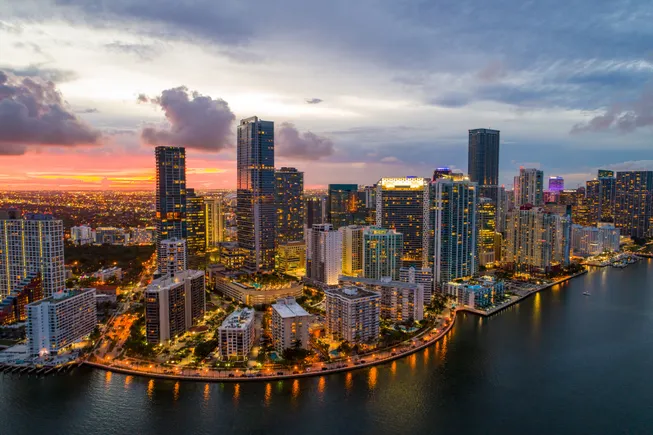
Entering 2023, Miami was one of the top markets on the radar of hotel investors and developers, with its RevPAR at the end of 2022far exceeding 2019 levels, and travel demand persisting.
However, as time went on, the year-over-year decline in the market's RevPAR seemed to signal "trouble in paradise." But as local hotel industry experts told Hotel Dive, year-over-year data does not fully capture the market's post-pandemic recovery picture. Instead, experts remain optimistic about Miami's success, especially as business travel in the city begins to recover and the number of luxury hotel projects increases.
The post-pandemic picture
According to CoStar data, in every quarter so far in 2023, Miami's RevPAR has declined year over year—down 1.3% in the first quarter, 15% in the second quarter, and 9.4% in the third quarter. ADR followed a similar trajectory, declining year over year in each of those quarters.
A mid-year 2023 report from commercial real estate investment sales brokerage Marcus & Millichap noted that Miami's performance decline maystem from the stabilization of tourism rates. The report detailed that in the post-pandemic years, Miami's tourism boomed due to its relatively lenient health restrictions while many other destinations remained closed.
In 2021,24.2 million tourists visited the Miami area, which according to a report from the Greater Miami Convention & Visitors Bureau, was "basically on par with the total number of visitors in 2019." Another similar annual report from the bureau showed that in 2022,tourism levels grew by 9.5%, with Miami hosting 26.5 million visitors. The report stated that tourism in 2022 generated 17.1 million hotel room night sales, a 12.7% increase from 2021.
But the Marcus & Millichap report detailed that in 2023, tourism levels began to plateau, a trend exacerbated by high inflation rates and changing traveler preferences. As Miami's tourism growth slowed this year, market performance declined accordingly. However, Robert Hunter, senior vice president of investments and senior director of the hospitality division at Marcus & Millichap, told Hotel Dive that looking only at year-over-year metrics can skew perceptions of market growth.
For example, according to CoStar data, compared to the same period in 2019, RevPAR and ADR in the third quarter of this year remained significantly above pre-pandemic levels, up 14% and 20%, respectively. Although leisure travel has decreased since the post-pandemic boom, business travel is beginning to emerge in Miami—which Hunter and his Marcus & Millichap colleague Leo Reilly say is directly impacting the hotel industry.
Business travel boom
According to Reilly, some Miami neighborhoods, including Coral Gables and Coconut Grove, have seen a recent uptick in business travel, and he said the office sectors in these submarkets are thriving.
"Many large companies have announced opening new offices. For example, Virgin Hotels just announced it will lease space in Coconut Grove to accommodate 500 employees, and FIFA will relocate 100 employees to Coral Gables," Reilly said. He noted that when a city's office market performs well, it is often good news for hotels, because people travel to those headquarters—especially considering many employees work remotely and need to stay in hotels when visiting the office.
According to Marcus & Millichap's mid-year 2023 report on the Miami-Dade County office market, the metro area isseeing sustained demand from large corporate companies. Companies relocating to Miami by the end of 2024 include Blue Legacy Ventures, Innovation Refunds, and Fortress. According to the report, these companies will collectively occupy 158,000 square feet of office space.
"(Miami) continues to develop into a major international city. The growth we are seeing in the commercial and financial sectors is very encouraging," Alessandro Colantonio, chief investment officer at Miami-based real estate investment and development company Gencom, told Hotel Dive. "Looking ahead five, ten years, we truly believe Miami will become a real financial center outside of New York."
"Looking ahead five, ten years, we truly believe Miami will become a real financial center outside of New York."
Alessandro Colantonio
Chief Investment Officer at Gencom
"We don't see this slowing down," he added. "Miami has a lot of room for growth."
Reilly noted that travel to Miami for conferences and events is also increasing. This is in line withNew York CityandDallas, among other markets, which saw group traveldrive profit and revenue growth。
Mixed-use projects dominate
To accommodate the market's growth in business travel, several of the city's major hotel projects under construction are part of large mixed-use developments, which typically include office, retail, residential, and hotel space.
One such project, Reilly noted, isMiami Freedom Park, which broke ground in the summer. The 58-acre mixed-use development will include parks and green spaces, a tech center, restaurants and shops, community soccer fields, and a 25,000-seat stadium for the Inter Miami soccer team. Reilly said 750 hotel rooms are also planned.
Another mixed-use development that Reilly noted will "completely transform the surrounding area" isGencom's Miami Riverbridge project. The development will bring approximately 190,000 square feet of meeting and event space, residential condominiums, new public green spaces, and a "reimagined" 615-room Hyatt hotel to the market.
According to Gencom's Colantonio, part of the reason this year was "the right time to launch (Miami Riverbridge)" is due to "the continued excitement, positive trends, and more demand for the city market and city hotels in terms of business travel."
Colantonio told Hotel Dive that the company also plans to update its luxury Ritz-Carlton Key Biscayne property to adapt to changing traveler needs, including luxury travelers seeking "bigger and better" amenities.
According to Andrew Dickey, managing director of JLL's Hotels & Hospitality investment sales team in Miami, luxury developments in Miami are increasing. He said that following a globalincrease in luxury travel demand, the luxury segment is growing faster in the market than any other segment. Dickey noted that some luxury hotels in the market include Faena Hotel Miami Beach, The Miami Beach Edition, 1 Hotel South Beach, and Four Seasons Hotel at The Surf Club.
Dickey noted that many of the luxury hotel projects in the market are also mixed-use and include residential components, including theWaldorf Astoria Hotel and Residences, currently under construction in Miami's central business district. The luxury project is set for completion in 2027 and will become Miami's tallest tower at 1,049 feet. Shared amenities between the hotel and residences will include multiple dining concepts, meeting and event space, a spa, and a fitness center with private training facilities.
Asimilar projectin the market is the Mandarin Oriental hotel and branded residences on Brickell Key, which will replace the existing Mandarin Oriental, Miami. The dual-tower luxury development is scheduled for completion in 2030 and will feature 151 hotel rooms and 220 residential units. The two towers will be connected by and share a 100,000-square-foot amenity podium featuring multi-level infinity pools, private cabanas, restaurants and bars, flexible meeting and event space, and a spa.
Overall, according to data from Lodging Econometrics shared with Hotel Dive, Miami currently has 60 hotel projects in the pipeline, totaling 10,564 rooms.
Investor interest
Dickey said there is "strong investor interest in Miami," noting that the market is seeing more high-net-worth buyers compared to past cycles. Marcus & Millichap's Hunter agreed that "larger, well-capitalized" groups are the primary buyers in the market currently, as these investors have the ability to "absorb higher debt service costs to acquire quality assets in the market."
However, Dickey said that due to healthy RevPAR growth compared to pre-pandemic levels, many hotel owners in the market are still holding onto their assets. Nevertheless, transactions are still taking place.
Earlier this year, JLL's Hotels & Hospitality Groupcompleted the $835 million sale of the 1,000-room Diplomat Beach Resort in Hollywood, a suburb north of the Miami metro area. The company also recentlyfacilitated the $53.5 million sale of SLS Brickell, a 124-room luxury lifestyle hotel in Miami's Brickell neighborhood. Earlier this month, anupscale Even hotel near Miami International Airport was sold. Reilly noted that investment activity in submarkets near the airport, including Doral and Blue Lagoon, has been active.
